

Summary
Carbon standard: Rainbow Standard
Credit Type: Removals through Nature-Based+ solutions
Carbon standard: Social Carbon
Pathway: Biomass Storage (biobased construction materials)
Project Overview
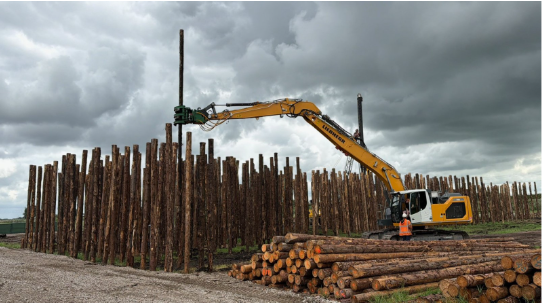
Underground Forest drives sustainably sourced Norway spruce piles deep into waterlogged peat and clay in the Netherlands, where they serve as foundations for buildings in place of concrete. Kept below the groundwater table, the wood is starved of oxygen, so it does not decay and its carbon stays stored. The approach builds on a construction technique the Dutch have relied on for centuries, with millions of wooden piles still sound in the ground today. Underground Forest works with the Huet Group as its long-term timber supply partner and with Normec Verifavia as its accredited verifier.
Responsible harvesting, not virgin extraction
The project sources PEFC-certified spruce from sustainably managed forestry in the Belgian Ardennes, with harvesting kept below the forest’s net annual increment. This supports continued forest cover and responsible harvesting rather than virgin extraction elsewhere.
The project creates steady work for SME pile-driving contractors and timber suppliers, while providing a practical route to decarbonise construction. By displacing carbon-intensive concrete with a wood alternative, backed by real municipal and corporate demand (Provincie Utrecht is among its buyers), it strengthens the Dutch biobased construction supply chain.
The Underground Forest approach – three solutions
Underground Forest’s approach tackles durable carbon storage, the embodied emissions of construction and the future use of soft peatland through a single building process.
Foundation Piling: Sustainably sourced spruce stems are driven vertically below the groundwater table into anoxic peat and clay, where they serve as building foundations. Isolated from oxygen, the wood resists decay, holding its carbon in place for centuries.
Sustainable Sourcing: The spruce is PEFC-certified roundwood from managed forests in the Belgian Ardennes, supplied through a long-term partnership with the Huet Group. Harvesting stays below the forest’s annual growth, and the wood is used whole, without chemical treatment or preservatives.
Peatland Livelihoods: Working with local landowners and farmers, the project builds stable foundations on soft and rewetted peatland, helping communities keep the land in use as water tables rise. Landowners share in the credit revenue, and Dutch pile-driving contractors take on new work.
Permanence Risk Assessment
Carbon is stored for the life of the building in timber piles kept permanently below the water table, where the absence of oxygen prevents decay. The project is credited conservatively at 100 years, based on measured decay rates, and this approach has been validated by Normec Verifavia. The main dependency is that piles remain below groundwater.
Details on MRV for methodology and project
The project is certified under the Rainbow Standard, a programme labelled as CCP-eligible by the ICVCM, making Underground Forest the first Dutch project developer with credits issued under such a programme. Monitoring currently relies on satellite and groundwater data, with Normec Verifavia acting as the accredited Validation and Verification Body (VVB).
Permanence Risk Assessment
The project’s permanence risk was assessed using the SOCIALCARBON AFOLU Non-Permanence Risk Tool, which evaluates internal, external and natural risk factors. It received a low risk rating of 10, meaning 10% of its carbon removals go into a buffer to insure against reversals. This rating reflects low wildfire risk, soil-stabilising regenerative agricultural practices, and 30-year renewable agreements with implementation partners and farmers that extend beyond the initial crediting period
.
Leakage Risk Assessment
Leakage is assessed under the SCM0005 v2.0 methodology across three sources: declines in crop productivity, increased use of non-renewable cooking fuel, and manure brought in from outside the project area. It is set to zero because all manure and compost are produced on-site without displacing livestock, and project farmers mainly cook with LPG, so they are unlikely to switch to burning crop residues. As a safeguard, Boomitra carries out productivity studies every ten years, and any project-related yield decline greater than 5% triggers immediate credit deductions.
Details on MRV for methodology and project
The project’s monitoring, reporting and verification (MRV) follows the SCM0005 v2.0 methodology. It measures soil organic carbon to 30 cm at pixel level using remote sensing and machine learning models, calibrated against over 1 million ground-truth samples from India’s National Soil Health Card dataset. Management practices such as reduced tillage and fertiliser use are tracked through annual surveys, geospatial monitoring and the Boomitra Farmer and Rep apps. The data feeds into monitoring reports that an independent Validation and Verification Body (VVB) verifies at set intervals.