

Farm Gate Podcast: How to accelerate nature markets
This article was authored by Ffinlo Costain, Chief Editor at 8point9 and follows the latest episode of the Farm Gate podcast where Luke Baldwin, CEO at Nature Broking explores what needs to change in a conversation with Ffinlo Costain, Lucy Jenner of Savills, Alastair Grizzll of Ark Consultancy & Events.
Voluntary nature markets are struggling to attract the demand at the scale needed to deliver environmental recovery, but natural capital specialists say regulatory pressure, better financial mechanisms and a more strategic approach to land management could unlock new opportunities for farmers.
Nature markets have promised farmers and landowners a new source of income for more than a decade. By restoring peatlands, creating wildlife habitats, planting trees and improving soil and water management, land managers could generate income from businesses seeking to meet environmental commitments.
But the market has yet to deliver at the scale many anticipated. While the supply of potential carbon and biodiversity credits is growing, demand remains limited, projects can be expensive to establish, and farmers face uncertainty over future prices, contracts and the implications for their land. The challenge now is to turn nature from a voluntary environmental ambition into something businesses regard as essential infrastructure.
Voluntary markets are not enough
Baldwin framed the current situation, saying that the carbon market had undergone a significant reset following high-profile criticism of carbon credits in 2023, when questions were raised about whether some projects were delivering the environmental benefits they claimed. Previously, businesses had bought credits partly because their competitors were doing so. But that incentive weakened when confidence in the market was damaged. Now buyers are increasingly asking what value credits deliver to their businesses, rather than simply treating them as evidence of environmental commitment.
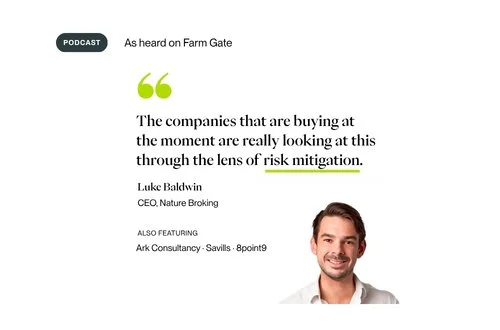
“The companies that are buying at the moment are really looking at this through the lens of risk mitigation,” Baldwin explained. That includes protecting supply chains, strengthening infrastructure against environmental disruption and preparing for future regulation. Businesses working towards net zero will also need to address residual emissions that cannot be eliminated entirely. Baldwin believes some companies are buying credits now to hedge against the risk of higher prices as demand eventually grows.
What's selling?
For farmers the immediate reality remains a buyer's market, with more potential supply than demand. The available markets include the Woodland Carbon Code, the Peatland Code, regenerative agriculture carbon credits, biodiversity net gain (BNG) and emerging opportunities around water quality, flooding and drought resilience. Biodiversity net gain, which requires most developments in England to deliver a 10% increase in biodiversity, has created a statutory market.
Voluntary biodiversity credits, by contrast, are developing more slowly. Jenner argued that voluntary markets remain important for innovation and early adoption, but are unlikely to generate investment at the scale required to reverse nature loss. She pointed to the water industry as an example of how regulation can create demand. Investment in environmental improvements, catchment management, habitat restoration and peatland recovery is being driven by regulatory obligations rather than voluntary corporate commitments alone. Mandatory nature-risk disclosure could have a similar effect across the wider economy. If businesses are required to identify and report their dependencies on nature, along with their impacts on biodiversity, those issues become board-level financial risks rather than peripheral environmental concerns. Regulation, Jenner argued, would not deliver nature recovery by itself. But it could provide the demand signal needed for private investment to follow.
Water companies offer an opportunity
Water management is emerging as a significant opportunity for nature-based solutions, with investment potentially supporting farmers while addressing some of the industry's most pressing challenges.
Grizzell highlighted the current Asset Management Period 8 (AMP8), which runs from 2025 to 2030 in England. He said that, within the industry's overall investment programme of more than £100bn, approximately £3.3bn had been identified for nature-based solutions. The challenge is demonstrating that those investments will deliver the required results. Water companies are looking at approaches such as river restoration, planting trees along riverbanks and working with farmers to reduce agricultural chemical inputs. These interventions could significantly help to manage excessive winter flows, retain water through drier periods and improve water quality. Healthy soils are important because they can absorb and store water, reducing rapid runoff while helping maintain supplies during dry weather. However, nature-based infrastructure presents a different financial proposition from conventional engineering. Concrete infrastructure can be treated as a capital asset, whereas payments for environmental outcomes may be classified as operational expenditure, making them harder to finance over the long term.
Baldwin argued that this accounting distinction is a fundamental barrier to investment. He suggested that government should consider how green infrastructure could be financed more like conventional infrastructure, allowing greater volumes of capital to flow into environmental projects. Insurance and independent verification could also help make projects more investable by giving buyers greater confidence that promised outcomes will be delivered.
Farmers need a strategy, not just a scheme
For farmers considering natural capital markets, the prospect of combining private income with government support can be attractive, but it requires careful planning. Jenner stressed that farmers must avoid being paid twice for the same environmental outcome. However, different income streams may be combined where they pay for distinct benefits and the relevant scheme rules permit it. For example, public funding might support changes in farming practices, while a private buyer pays for a separate water-quality benefit or additional habitat enhancement. The important question is not simply what work a farmer can undertake, but which environmental outcomes the land can deliver and whether there is a buyer willing to pay for them.
Jenner warned against assuming that creating an environmental asset will automatically generate a market. Farmers must also consider who owns the resulting environmental benefits, how they can be sold, the duration of contracts, how public and private funding interact, and whether participation could affect future grant eligibility. The process of establishing a biodiversity habitat bank can involve identifying suitable land, commissioning ecological surveys, designing a scheme, securing finance, completing legal agreements and registering the project before units can be sold. Such projects can require substantial expertise and long-term commitments. BNG agreements typically run for at least 30 years, raising questions about land values, inheritance, succession planning and the ability to sell or mortgage a holding.
Yet Jenner cautioned against assuming that natural capital projects must always be prohibitively expensive. Farmer clusters can help spread costs, share knowledge and distribute risk. She cited the Pentland Land Managers Association, near Edinburgh, as an example of farmers learning from one another and developing a mechanism to share potential natural capital income. Her advice was to avoid both extremes: dismissing the market as a passing fad or entering it without a clear strategy.
Nature must work alongside food production
The discussion also highlighted a concern about the distribution of natural capital income. Large landscape-scale projects can attract substantial public and private investment, particularly where they address specific challenges such as flooding or peatland degradation. But farmers outside those areas may have fewer opportunities to participate.
Jenner acknowledged the fairness concern, while arguing that collaboration can help farmers undertake work they might struggle to deliver individually. Grizzell added that investment often follows the location of a particular environmental problem, meaning funding is directed towards areas where it can achieve wider benefits. For farmers, the objective should be to understand how environmental improvements can support the whole business rather than treating food production and nature recovery as mutually exclusive.
Grizzell argued that farms should be considered as integrated systems combining livestock, cropping and nature, rather than separating them into competing land uses. That approach could also help food companies recognise the wider environmental benefits associated with the farms supplying their products.
Baldwin said multifunctional landscapes must be supported by robust due diligence. Buyers need confidence that projects deliver genuine benefits, that outcomes are not double-counted and that environmental claims can be verified. Technology, satellite monitoring, insurance and independent assessment are all developing to help manage those risks. But Jenner warned that long-term projects must also account for a changing climate. A woodland or restored peatland may face very different conditions decades from now, so monitoring and management plans need sufficient flexibility to respond to changing ecological realities.
Building a market that can survive political change
The future of natural capital markets will depend partly on government policy, including the durability of biodiversity net gain and other environmental obligations. Baldwin argued that markets built entirely around regulation are vulnerable to political reversal. Businesses are more likely to continue investing if they can identify clear financial benefits, including reduced supply-chain risks and the creation of assets with demonstrable value.
Jenner believes government still has three important roles: regulating, purchasing environmental outcomes where appropriate, and acting as a guarantor of last resort. She pointed to Scotland's peatland carbon contract pilot as an example of how government might reduce investment risk by providing a minimum future price for a proportion of carbon units, while allowing landowners to benefit if market prices rise. Ultimately, she said, farmers should make decisions according to their individual circumstances. Some may choose to sell future carbon units now to secure a price and help finance restoration; others may undertake funded work while keeping their options open. The common requirement is a carefully considered plan that accounts for the characteristics of the land, the needs of the farming business and the realities of the market.
Natural capital markets have not yet delivered the widespread new income stream that many farmers hoped for. But the discussion suggested that the opportunity has not disappeared. Unlocking it will require more than producing credits: it will mean creating reliable demand, reducing financial barriers and recognising nature as part of the infrastructure on which farming and the wider economy depend.